A practical guide to portable comfort
Travel Pillows Explained: Comparing Wool, Silk, and Packable Support
The right travel pillow is less about finding a miniature version of your bed and more about choosing portable support that suits the journey. Wool, silk, and other compact constructions each bring a different balance of cushioning, weight, shape, and care.
Travel changes the conditions in which a pillow has to work. A familiar mattress is replaced by an airplane seat, a train compartment, a guest room, or a hotel bed with an unfamiliar profile. The pillow may spend hours tucked into luggage, then be expected to feel comfortable after a long day. In that setting, details that seem minor at home—fill, cover, dimensions, and cleaning instructions—can become decisive.
A travel pillow can mean several things: a compact pillow for a hotel stay, a small cushion for a car or train, or a neck-shaped support intended to sit around the shoulders. This guide focuses on portable pillows for resting away from home, comparing wool and silk constructions while considering the broader questions that help a travel pillow earn its place in a bag. The aim is not to promise better sleep on every journey, but to make the choice more informed.
Material alone does not determine comfort. The pillow’s height and shape need to match the way it will be used, while its packed size and maintenance requirements should fit the traveler’s routine. A beautifully soft pillow may be inconvenient if it is bulky or difficult to clean; a compact one may disappoint if it collapses under the head. A thoughtful choice balances both.
First, define what “travel pillow” means for you
Before comparing fibers, picture the moment you expect to use the pillow. Someone taking an overnight flight may want a cushion that stabilizes the neck while seated. Someone staying in a succession of hotels may prefer a small, familiar pillow for the bed. A road-trip passenger might want something easy to shift between the head, lower back, and shoulder. These are different jobs, and a single design may not serve all of them equally well.
Travel pillows generally fall into a few practical formats:
- Compact bed pillows: Small rectangular or square cushions for overnight stays, guest rooms, or travelers who prefer a familiar layer on an unfamiliar bed.
- Neck pillows: Curved or U-shaped supports intended to fit around the neck while sitting. Their performance depends on shape, seat position, and personal comfort.
- Compressible pillows: Soft, flexible designs that can be squeezed into a bag or arranged to suit different positions, although repeated compression may change their feel.
- Small supportive cushions: Portable pieces used behind the back or alongside the body rather than directly under the head.
Think about whether the pillow will be carried in a backpack, a small personal item, or a suitcase. A pillow that is easy to bring in a car may be too large for a tightly packed carry-on. Consider whether it needs to work while upright, lying down, or both. That simple distinction can narrow the options before material becomes the focus.
Wool travel pillows: cushioned, resilient, and care-conscious
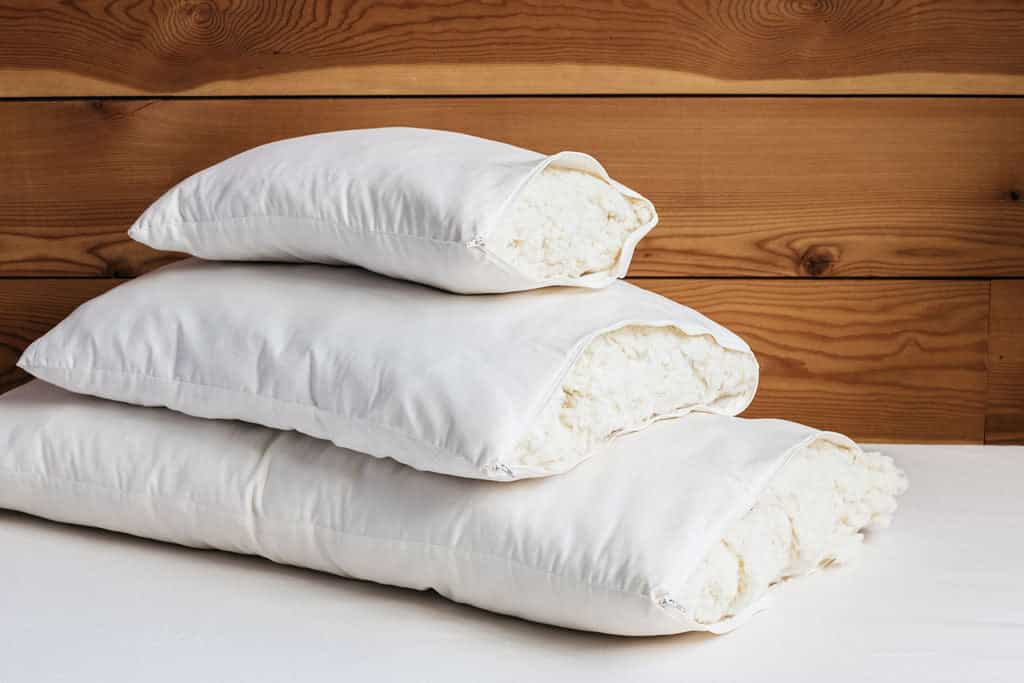
Wool is a natural fiber with a distinctive, gently springy feel. In pillow construction, it may be used as batting, loose fill, or small wool puffs held inside a fabric case. These forms do not behave identically: batting tends to create a more unified layer, while loose or puffed fill can feel more adjustable and shapeable. A wool pillow may suit travelers who want a cushioned, less slick surface and appreciate a material with substance.
Wool’s feel is often described as resilient rather than fluid. It can compress under pressure and recover to some extent, but its response is different from the sinking sensation of some foams or the airy softness associated with down. For a portable pillow, this can be useful when a little structure is welcome. It may also mean that a particular wool design feels too firm or substantial for someone who prefers a very light, collapsible cushion.
Construction matters more than the word “wool” on a label. A compact pillow filled with wool may be relatively easy to pack, but its dimensions and firmness determine how portable it feels in practice. Adjustable designs allow the user to remove or add fill, which can help fine-tune loft at home. On the road, however, an adjustable case is only convenient if there is a clean, practical way to store any removed fill. For most travelers, choosing a suitable loft in advance is simpler than adjusting the pillow mid-trip.
Some wool pillows are spot-clean only, while their separate covers may be washable. Others have a removable outer layer with its own care instructions. These distinctions are especially important when traveling: spills, perspiration, and contact with shared surfaces are ordinary possibilities, not unusual mishaps. Read the care label before packing, and do not assume that a natural fill can be put in a washing machine. Wool can be damaged by unsuitable washing, heat, or drying methods.
For a representative example of wool construction, the All-Natural Travel Pillow is a compact option filled with premium eco wool and supplied with a separate organic cotton sateen case. Its listed care guidance distinguishes between the spot-clean-only pillow and the washable separate case. That split is useful to understand before travel: the removable case can be refreshed more easily than the fill itself, so a washable cover or protector can be a practical extra layer.
Wool is not automatically the best choice for every traveler. A person who wants the smallest possible packed volume may prefer a lighter, more compressible design. Someone sensitive to particular fibers should check the full material description and consider whether the pillow’s surface and fill feel comfortable against the skin. The most reliable measure is the specific construction, not a broad assumption about the material category.
Silk travel pillows: a smooth surface in a compact format
Silk is often chosen for its smooth, cool-feeling surface and light touch. In travel pillows, it can appear as a cover, a component of the fill, or part of a layered construction. A pillow described as “silk” may not be made entirely from silk, so it is worth checking which components use the fiber. The cover, cushion filling, and any internal support may each be different materials.
A silk travel pillow can appeal to someone who values a soft, sleek surface and wants a cushion that feels refined rather than bulky. Yet a smooth hand does not tell you how much support the pillow provides. Support depends on loft, fill amount, shape, and how the cushion responds when compressed. A lightweight pillow with a pleasing cover may be a comfortable travel companion, but it may not offer enough height for every sleeping position or seat.
Care deserves particular attention. Silk can require a delicate wash cycle, mild detergent, limited water temperature, and air drying. Those instructions may be manageable at home but less convenient on a short trip. Before packing, check whether the whole pillow is washable or only a removable cover, and whether the care method requires time or facilities that will be available during the journey. When the pillow is used frequently, a protective case can reduce the need to clean the main cushion after every trip.
Silk also appears in mixed-material constructions. One compact travel cushion, for example, combines a Mulberry silk element with a polyester core and a cotton sateen casing. Such a design illustrates why material labels should be read as a description of the whole build, not a promise that every component is silk. The blend can affect weight, loft, resilience, and care requirements. If the feel of silk is the primary reason for choosing a pillow, confirm which surface actually touches the skin.
For many travelers, silk is best considered a surface and comfort preference rather than a guarantee of a particular level of support. The same is true of wool: the fiber contributes to the experience, but shape and construction determine whether the pillow works for a given journey. Comparing a silk cover with a wool-filled pillow is therefore not a strict like-for-like test. Look at the complete specification and the intended use.
Wool versus silk: the differences that matter on the road
There is no universal winner between wool and silk because they answer different priorities. Wool often brings a more substantial, resilient cushioning feel; silk is commonly valued for its smoothness and lightness. Neither description predicts the exact sensation of a particular pillow, and blends may change the character of either material. The comparison becomes clearer when organized around everyday travel questions.
| Consideration | Wool construction | Silk construction |
|---|---|---|
| Typical feel | Often springy, cushioned, and more substantial | Often smooth and light to the touch |
| Support potential | Depends on fill type, amount, and pillow shape; some designs hold a defined form | Depends on the complete construction, including any core or additional fill |
| Packing | May feel denser; check dimensions and whether the pillow compresses safely | May be light, but packed volume still depends on the shape and inner materials |
| Care | Often requires spot cleaning of the fill; removable covers may be washable | May require delicate washing or careful air drying, depending on the build |
| Best comparison question | Does the pillow provide enough cushion without taking up too much space? | Is the surface pleasant, and does the full pillow provide enough support? |
Use the table as a starting point, not a substitute for product details. “Wool” does not mean every pillow is firm, and “silk” does not mean every pillow is feather-light or machine washable. Fill volume, casing fabric, seams, shape, and size all influence the result. When descriptions are vague, prioritize measurable information such as dimensions and explicit care instructions.
How to judge portable pillow support
Support is the balance between the pillow’s height and the space it is meant to fill. For a bed pillow, the distance between the head and mattress changes with sleeping position and shoulder width. For a seated traveler, the back of the seat and the angle of the headrest affect how a cushion behaves. A pillow that feels comfortable at home may not maintain the same position in a narrow airplane seat or a moving vehicle.
Look at the shape before looking at claims about comfort. A rectangular travel pillow can be repositioned, but it may slide if the fabric is very smooth or the seat is upright. A curved neck pillow can stay around the shoulders, although its shape may not suit every neck or seat. A small, flexible cushion can serve several roles, but multi-use design is only helpful if it remains stable enough for the task.
When possible, test the pillow in the position where you expect to use it. If that is not practical, use the listed dimensions and consider how they compare with a cushion you already own. Ask whether the pillow’s thickness is stated when compressed or uncompressed, whether the fill can be adjusted, and whether a cover changes the overall feel. Small differences in height can be more important than a broad label such as soft, medium, or firm.
A travel pillow should not be treated as a medical device or a guaranteed remedy for pain, snoring, reflux, or sleep disorders. People with persistent discomfort or a diagnosed condition should seek guidance from a qualified health professional about suitable positioning and support. For general travel comfort, the sensible goal is modest: choose a cushion that fits the space, feels agreeable, and is manageable to carry.
The packing question: size, weight, and shape
Portable support must be portable in practice. A pillow can be small enough to fit into luggage yet inconvenient to retrieve, attach, or store during a journey. Measure the space available in your bag and compare it with the pillow’s actual dimensions. If the manufacturer provides a packed size, check whether that refers to compression in a pouch or simply to the pillow as sold.
Consider weight alongside volume. A denser pillow may provide a reassuringly stable feel but add noticeable weight to a bag carried for several hours. A soft, compressible pillow may pack more easily, yet could need time to regain its shape after being squeezed. Avoid assuming that a pillow can be tightly rolled or compressed unless its care guidance supports that handling. Some fills may flatten, shift, or become difficult to redistribute.
- For carry-on travel: Choose a design that fits your available personal-item space without displacing essentials.
- For road trips: Consider whether the pillow can be kept within reach and repositioned easily.
- For frequent hotel stays: A compact bed pillow may be more useful than a neck-shaped cushion.
- For occasional journeys: A pillow already used at home may be more familiar, provided it is easy to transport.
A removable case can help keep the pillow clean while it is in a bag. Store the pillow in a dry compartment, separate from toiletries or damp clothing, and let it air after use when the material’s care instructions allow. A washable case or protector adds convenience without requiring the inner fill to be laundered.
Care and hygiene away from home
Care instructions are part of the travel decision, not an afterthought. If a pillow is spot-clean only, plan to use a washable cover and handle small marks promptly according to the manufacturer’s directions. If the cover is removable, check how it is washed and dried. If the entire pillow is washable, verify that it can dry thoroughly before being packed again. Damp fill stored in a closed bag can develop an unpleasant odor and may be difficult to refresh.
Wool fills and delicate silk components can have more specific needs than ordinary cotton cases. Follow the product label rather than applying a general cleaning rule. Avoid heat, harsh detergents, or vigorous agitation unless expressly permitted. For pillows with mixed materials, the safest care method may be determined by the most delicate component.
For a trip, a practical routine is simple: pack the pillow clean and fully dry, use a removable case, and keep the case separate for laundering when you return. A small fabric bag can protect the cushion from abrasion and dust in luggage. If the pillow has a zipper or adjustable fill, keep it closed during transport to prevent fill from escaping. These habits help a portable pillow stay pleasant without turning care into a complicated travel ritual.
A considered checklist before choosing
Use this short checklist to compare travel pillows on their actual merits:
- Purpose: Will it support the head in bed, the neck while seated, or another part of the body?
- Position: Is it intended for lying down, sitting upright, or flexible use?
- Dimensions: Will it fit the space and provide enough height or width?
- Fill and feel: Does the material feel springy, soft, smooth, or firm in a way you enjoy?
- Packed size: Can it travel without becoming a burden or taking over your bag?
- Cover: Is the outer layer removable, washable, or easy to protect?
- Cleaning: Are the instructions realistic for your schedule and travel habits?
- Material details: Does the description explain the cover and fill, or only use a broad material label?
- Allergies and sensitivities: Have you checked every component that may touch your skin or face?
When comparing two options, give extra weight to the feature that matters most to your route. For a frequent flyer with limited luggage space, low packed volume may come first. For someone staying away from home for several nights, a comfortable familiar shape and an easy-to-wash cover may matter more. A traveler who plans to use a pillow in several settings should look for a form that can be repositioned without losing its purpose.
A better journey begins with realistic expectations
A travel pillow cannot transform every seat into a bedroom or guarantee uninterrupted rest. Its value is more practical: a familiar surface, a little extra cushioning, or a support shape that makes it easier to settle. Wool and silk each offer distinct material qualities, but neither is inherently superior. The best option is the one whose shape, feel, size, and care requirements align with the way you actually travel.
Start with the setting, then consider the material. Choose wool if you prefer a more substantial natural-fiber cushion and are comfortable following its care instructions. Consider silk if a smooth surface and a light, refined feel appeal to you, while checking the full construction and washing requirements. If neither description tells you enough, look for clear dimensions, a removable cover, and transparent details about the fill.
In the end, portable pillow support is a personal equation: how the cushion feels, where it needs to fit, what you are willing to carry, and how easily you can keep it fresh. Read beyond the name on the label, test the shape whenever possible, and let the journey—not the trend—set the criteria.